
Journal
After Cyclone Senyar: What Sumatra's Deadly Floods Revealed About Its Forests
The landslides and flash floods of November 2025 killed about 1,200 people. Indonesia then revoked 28 companies' permits upstream, and researchers questioned the list. A look at what changed, and what did not.
In November 2025, Cyclone Senyar brought landslides and flash floods to Sumatra that killed about 1,200 people.[1][2] Almost a year later the disaster is remembered for a second reason: the government's decision to hold some of the companies with forest and mining concessions upstream responsible, and the argument that followed over whether it had chosen the right ones.
From promise to revocation
The first step came within weeks. On 4 December 2025, Forestry Minister Raja Juli Antoni told the parliament's forestry commission that, once President Prabowo approved it, his ministry would revoke about 20 forest utilisation permits covering roughly 750,000 hectares across Indonesia, including in Aceh, North Sumatra and West Sumatra, the provinces hit by the floods.[3]
The larger decision followed in January. A forest area enforcement task force, known as Satgas PKH and formed in January 2025, audited the concessions, and its findings were presented to President Prabowo Subianto on 19 January 2026.[1][2] The next day, State Secretariat Minister Prasetyo Hadi announced that the President had decided to revoke the permits of 28 companies found to have committed violations.[1]
Twenty-two of them were forest utilisation permits for natural and plantation forests, covering about one million hectares. The other six covered mining, plantations and the use of timber forest products.[1]
Welcomed, with conditions
Environmental groups welcomed the move and asked for more. The environmental group Walhi said revoking permits would mean little without a plan to restore the land. Greenpeace Indonesia asked for the companies and their violations to be set out clearly enough for the public to follow the enforcement, and argued that public safety must come before economic profit.[1]
The environment ministry's position was simpler: with the permits revoked, the companies can no longer operate.[1]
Questions about the list
A month later, the NGO Auriga Nusantara published an analysis that complicated the picture.[2] Among its findings:
- At least five forestry concessions on the list had already been revoked in a decree issued on 5 January 2022.
- The right-to-cultivate permit of a cocoa company in West Sumatra had expired in 2018 and was never renewed.
- Some revoked concessions lay outside the hardest-hit mainland watersheds, on the Mentawai Islands, Nias and Rupat, while some companies in badly affected catchments were left off the list.
One permit on the list belonged to the operator of the Martabe gold mine in North Sumatra. Indonesia's sovereign wealth fund, Danantara, said the mine could move to a new state company; the energy minister later said his ministry had not revoked the mining permit and that it was still under review.[2] Auriga's legal director asked whether the exercise was about protecting the environment or about taking over profits, and Walhi warned against simply replacing the managing company without changing the extractive model.[2]
Forests upstream, floods downstream
The government's decision rests on the link environmental groups drew after the disaster: that clearing forest in the upper reaches of a river basin leaves slopes and rivers less able to cope with extreme rain, and turns a storm into a disaster for the towns below.[1]
The pressure on Sumatra's forests has also shifted. In palm oil, the island is no longer the main frontier: the research group Trase finds clearing for oil palm there has fallen by more than 90 per cent from its historical highs, while Kalimantan now accounts for most of it.[4] We look at that shift, and what it means for everyday products, in Palm Oil Has Moved to Borneo.
What is still unanswered
The sources we consulted do not say how much of the revoked land will be restored, by whom, or when; whether the revocations will survive legal challenges; or how the land placed under state control will be managed. The number of permits and hectares also differs between announcements. Those are the questions to follow as the first anniversary of the floods approaches.
Disclosure: Plus Minus Lab, which publishes this site, makes body care and hotel amenities. Read more in the Journal, including the 2026 Kalimantan haze, or learn about us.
References
- Hans Nicholas Jong, "Indonesia revokes forest and mine permits over role in deadly Sumatra landslides", Mongabay, 22 January 2026.
- Hans Nicholas Jong, "Indonesia faces scrutiny over permit revocations following deadly floods and landslides", Mongabay, 20 February 2026.
- "Government to revoke permits of 20 companies amid Sumatra disaster probe", Indonesia Business Post, 5 December 2025.
- Jason Jon Benedict, Adelina Chandra, Robert Heilmayr and Akhmad Kamaluddin, "Indonesian palm oil exports and deforestation", Trase, 13 October 2026.
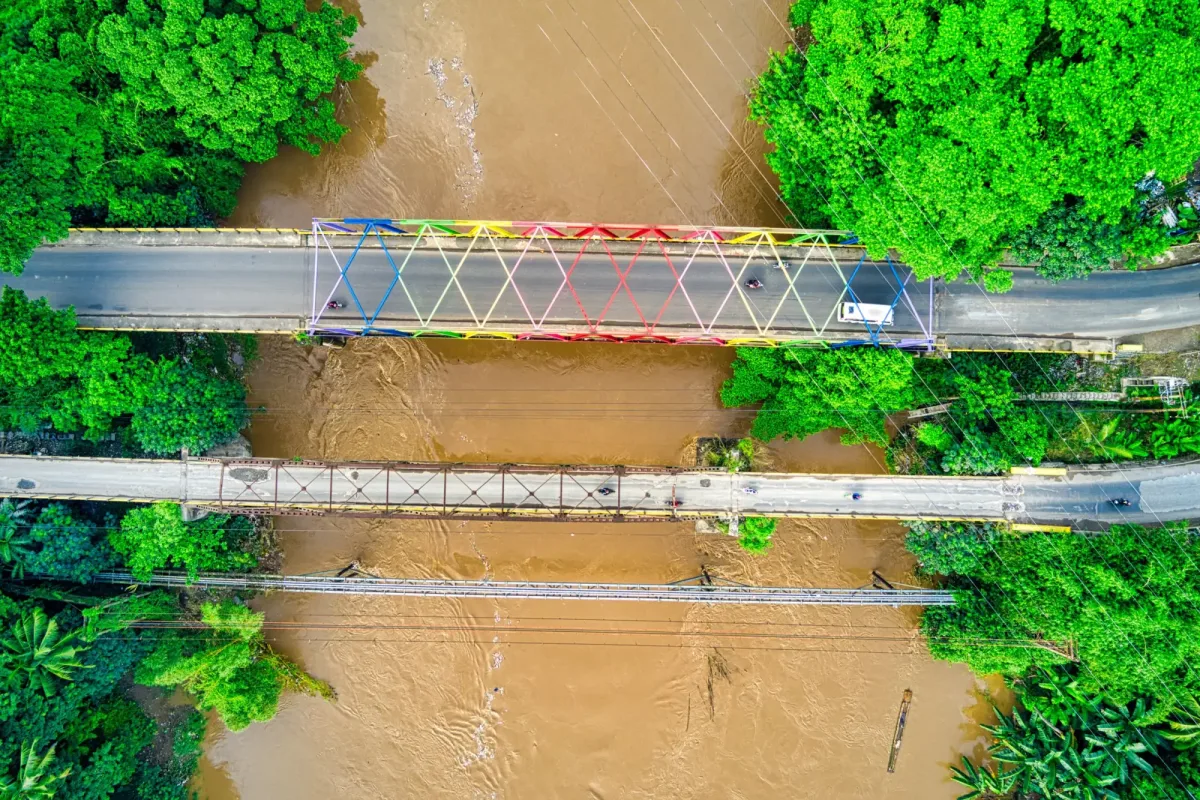
Cover photo: Tom Fisk / Pexels (flood water under bridges in Tangerang, Banten; not Sumatra). Links checked on 15 October 2026.